

Table of Contents
Patriot Systems Integration
Patriot is alarm monitoring automation software used by Alarm Receiving Centres, including Intelligent Monitoring Solutions (IMS). TetherX sends alarms to a Patriot control room over Patriot's own interface rather than by email, so every signal is confirmed as it is recorded, arrives with the camera identified, and carries the verification image with it.
What This Gives You
| Benefit | Description |
|---|---|
| Confirmed delivery | Patriot answers only once the alarm is recorded in its database. If it cannot be recorded, TetherX retries and reports the failure instead of assuming it arrived. |
| Named cameras | Each camera reports under its own number, so the operator sees which camera fired rather than a site-wide alarm. |
| Typed events | Person, vehicle, line crossing, loitering, tamper, camera offline and the rest arrive as distinct Patriot event types, so your control room can give each one its own action plan. |
| Verification image included | The snapshot travels inside the signal, so the operator sees it in Patriot without leaving the alarm. |
| Site position | The site's coordinates go with each alarm and appear on the account's Map tab. |
| Connection heartbeat | A control room account sends a heartbeat every minute, so the control room knows at once if alarms stop reaching it. |
| No port forwarding | As with every TetherX integration, nothing is opened on the customer's network. |
Choosing How a Site Signs In
Each site reports to Patriot in one of two ways. Ask your control room which one applies before you start.
| Connection | Use it when | What the site holds |
|---|---|---|
| Control room account | The control room issued one login for every site it monitors for you, and expects a heartbeat from the integration. IMS works this way. | The client number only. The login and the heartbeat are held once, on an operator account. |
| This site's own login | The control room issued a login for this site only. | The address, username, password and client number. No heartbeat is sent. |
Tip: With a control room account, a new site needs only its client number. The login and the heartbeat are already in place.
What Your Control Room Sets Up First
Ask your Alarm Receiving Centre to confirm all of the following. Each is a Patriot requirement, not a TetherX one.
- Internet Client Access with Extended Logins. The Patriot API is served by the control room's ICA host, and signal logging needs Extended Logins.
- A security group with the Log Signal right, and a user in that group created for TetherX. One user covers every site the control room monitors for you.
- That user assigned to each account TetherX will report against. Patriot refuses a signal for an account the user is not assigned to.
- The Standard Media Camera module, with the account's Camera Type set to Standard Media, if the operator is to see the verification image.
- An event type template covering the TetherX event numbers, so each alarm has a description and an action plan. Your control room can request the template from TetherX support.
Ask them for:
- the ICA address
- the username and password for the TetherX user
- each site's client number in Patriot, which includes the area and port, for example
0013BASE01 - the watchdog account number for the heartbeat, if you are using a control room account
Patriot documents these steps, with screenshots of each screen, in its own library:
- Setting up a JSON API user (opens in a new tab) - the security group, the user, and assigning it to an account
- Standard Media Camera (opens in a new tab) - the camera type that shows verification media to the operator
- Network Video Stream (opens in a new tab) - live video inside Patriot
- Test mode (opens in a new tab) - suppressing an account during maintenance
Setting Up a Control Room Account
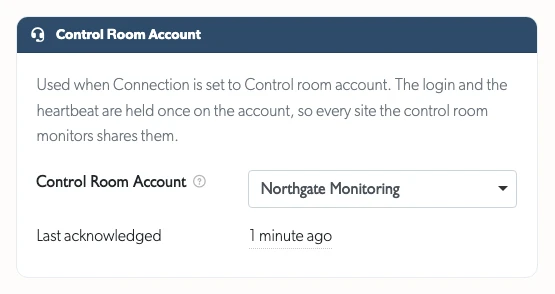
A control room account is an Operator account that stands for the control room. It holds the Patriot login and sends the heartbeat, and the control room's staff can sign in with it to open what each alarm links to. Integrators and TetherX staff can set one up.
Create an Operator account for the control room, as described in User Permissions. See User Types for what an Operator can do.
Give it access to the cameras of each site the control room monitors, on the Permissions tab. A site can only report through an account that can reach it.
Open the account and select the Control Room tab.
Enter the Patriot login your control room gave you:
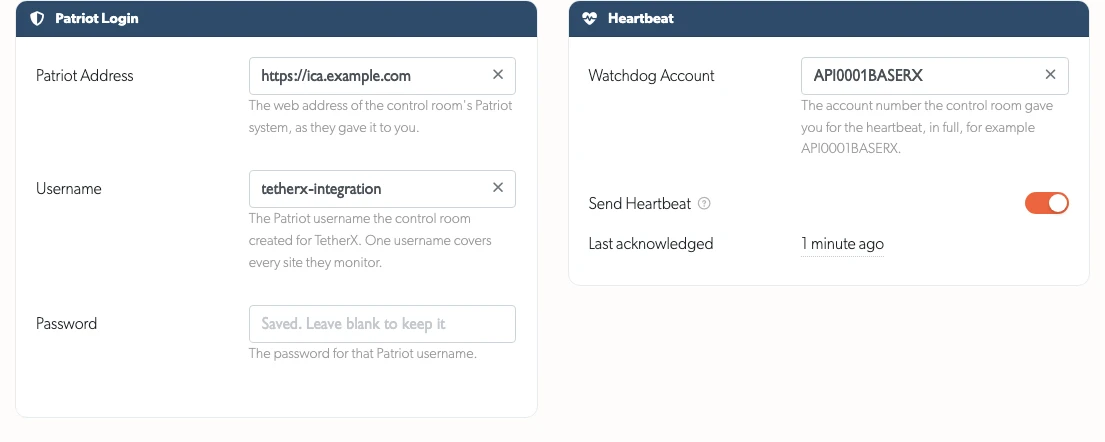
- Patriot Address: the ICA web address, for example
https://ica.example.com - Username and Password: the Patriot user created for TetherX
- Watchdog Account: the account number the control room issued for the heartbeat, in full
Switch Send Heartbeat on and select Update User. TetherX sends the first heartbeat within a minute, and Last acknowledged shows when the control room last confirmed one.
The password is never shown again once saved. Leave the field blank to keep it, or type a new one to replace it.
The Sites Reporting Through This Account list shows every site that uses the account:
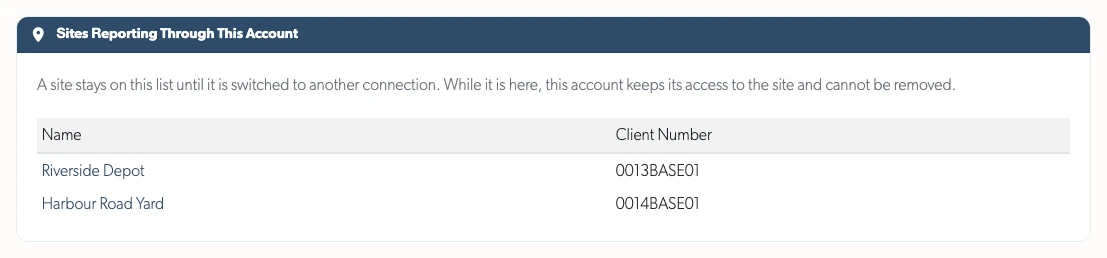
Warning: TetherX refuses to remove this account's access to a site on the list, deactivate the account, change its type or delete it. Switch those sites to another connection first, so no monitored site is left without a way to report.
Setting It Up on a Site
Select the Control Rooms tab, then Patriot Systems.
Choose the Connection and enter the site's details:
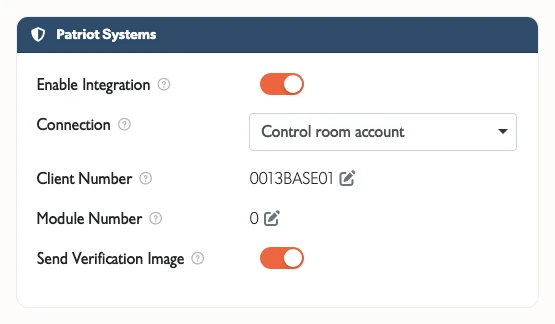
- Connection: Control room account or This site's own login
- Client Number: this site's Patriot account number, including area and port
- Module Number: leave at 0 unless your control room asks otherwise
- Send Verification Image: leave on so the snapshot goes with each alarm
With a control room account, choose the account under Control Room Account. Only active Operator accounts holding a Patriot login that can already reach this site are listed.
With this site's own login, enter it under This Site's Own Login:
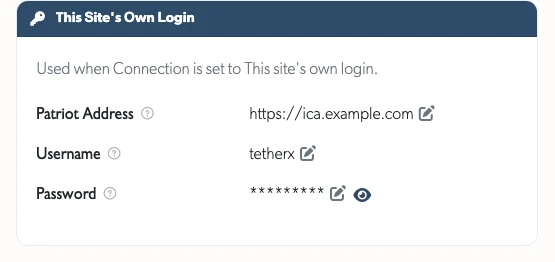
- Patriot Address: the ICA web address
- Username and Password: the Patriot user created for this site
Switch Enable Integration on. TetherX asks for the details the chosen connection needs first, so that a site cannot be left switched on with nothing to report to.

Once enabled, TetherX AI detections, camera analytics and VMD Events for this site are logged in Patriot as they happen, along with device and camera communication failures.
Camera Numbers
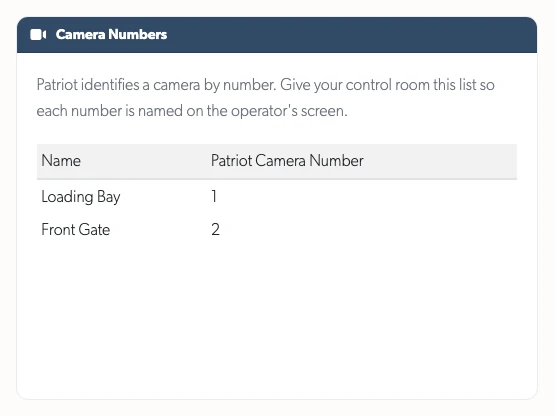
Patriot identifies a camera by number within the account. TetherX assigns each camera a number the first time it raises an alarm, and keeps it for the life of the camera.
The Camera Numbers list on the Patriot Systems tab shows the number for each camera at the site. Send that list to your control room so they can name each zone in Patriot. The operator then sees "Person Detected - Loading Bay" rather than a bare number.
Intelligent Monitoring Solutions (IMS)
IMS runs its monitoring platform on Patriot and issues one login per integration, so IMS sites use a control room account.
Your IMS contact provides:
| Detail | Where it goes in TetherX |
|---|---|
| API username (the password arrives separately, by a secure channel) | Username and Password on the control room account |
| API address | Patriot Address on the control room account |
| Heartbeat / watchdog account | Watchdog Account on the control room account |
| Client number for each site | Client Number on the site |
| ICA username | Not entered in TetherX. It signs in to IMS's own web interface, where you can review the signals TetherX sent |
IMS shows each client number in two formats. Enter the full format in TetherX: the account ID, the area and the port together, for example 1234BASE01. The short format with a hyphen, for example 1234-01, is only used in IMS's own interface.
IMS onboards every integration in a development environment first:
- Build and test against IMS's development environment with the test site account IMS assigns.
- Confirm the event codes with your IMS contact. IMS matches each code against the event template assigned to your account, so agree the TetherX event list with them during onboarding.
- Ask IMS to confirm they are receiving both alarms and heartbeats, and check the alarms in IMS's web interface.
- Give IMS your emergency contacts. IMS asks for them before going live, so they can reach you if the heartbeat stops.
- Switch to the production details IMS provides once testing is signed off. Update the address, login and watchdog account on the control room account, and the client number on each site.
Warning: In production, IMS expects a heartbeat at least every 60 seconds and alerts its operations team when one is missed. Keep Send Heartbeat on for as long as IMS monitors any of your sites.
Adding Live Video
Alarms carry a still image. For live video inside Patriot, your control room can add each camera as a Network Video Stream camera, which plays the stream in the operator's normal Patriot screen and in Patriot's web client.
- Go to the Control Rooms page
- Copy the URL for each camera
- Send them to your control room to enter against the matching camera zone
If Alarms Are Not Arriving
- Check the site is armed. A disarmed site reports nothing, by design.
- Check the client number. Patriot rejects a signal whose account number it does not recognise, including a number missing the area and port.
- Check the user assignment. Patriot refuses a signal if the TetherX user is not assigned to that account.
- Check the heartbeat. On the control room account, Last failure shows the reason Patriot gave for the last heartbeat it refused or did not answer. A login problem there affects every site using the account.
- Ask your control room to check the event type template. A signal that arrives with no matching event type reaches the operator without a description.
TetherX reports a rejected signal or a failed heartbeat to support with the reason Patriot gave, so raise a ticket if the settings look right and alarms are still missing.
Related Articles
- Control Room Software Integration - IMMIX, CONXTD and HikCentral
- User Types - What an Operator account can do
- User Permissions - Creating an account and giving it access to cameras
- Monitoring Station Operator Guide - Working alarms in the operator console
- Definitions - Event types and terminology
- Tunnelling to Network Devices - Remote access to on-site devices
Referenced in: